Wow. Today, I realized how much time flies. It seems like just last week I was writing the essay about the Stamp Act, and now, 5 months later, I realized that it has actually been this long since my last post. So many things have happened in my life, as young as I may be, that I cannot even begin to explain them, as much of a cliche as that might be. So, hopefully, after 6 months, I can try to get back to blogging, and hopefully a lot more than just once a month. So stay tuned... the show's not over!
Thursday, April 25, 2013

Monday, October 15, 2012
Do the Consequences Outweigh Rebellion Against the Stamp Act Itself? DBQ

- This is the stamp required on all paper bought by the colonists.
In the 18th century, during the ‘60s and ‘70s, colonial America was just recovering from the French and Indian War, which ended in 1763. Though the British and the colonists won the war, they crossed the Appalachian Mountains, and found more Native residents that they had to fight off. In order for Britain to protect the colonists from Native attacks, Britain had to find excess money that they could spend. The idea of taxing colonists was started by George Grenville of Parliament, via the Sugar Act. Due to this act, the slogan “Taxation without Representation” was adopted by the colonists in order to show that they deserve to have a say in whether or not they would be taxed, and on what. After the Sugar Act was ruined by the colonists, Grenville was forced to come up with a new idea- the Stamp Act (click here for the written law). This act was passed in March 1765, but rebels and rebel groups (within and outside of Parliament) forced it down before it even got up. George Grenville thought it was the fairest and easiest way to tax the colonists, but they thought that it was too direct. Rather than the taxation of goods and trading outside of America, this was taxing their everyday life. The Sons of Liberty had a big role in this. Also, Patrick Henry and William Pitt of Parliament stayed on the colonist’s side, and argued until the last days of the Stamp Act with them. These people were very brave, due to the scary consequences facing them if caught- they would be tried in the much hated Vice-Admiralty Courts. Even so, these people, and the many actions taken by normal colonists under their influence, started to change the way Parliament was thinking.

- The judges in Vice Admiralty courts were mainly appointed by King George III.
Many colonists refrained from going against the Stamp Act due to the consequences they knew would be coming. If caught, rebels would be tried in the abhorred Vice Admiralty Courts. The law said that "...offenses committed against any... act or acts of Parliament... shall and may be prosecuted, sued for, and recovered, in any.. court of admiralty, in the respective colony or plantation where the offense shall be committed, or in any court of vice admiralty appointed or to be appointed, and which shall have jurisdiction within such colony, plantation, or place...” (This quote is taken straight from the Stamp Act, a primary source. I chose this because it explains how people who go against the Stamp Act are forced to go to these courts.) There were only 11 of these in total, throughout all 13 colonies. This was because they were much more important than the normal Common Law Courts. They were mainly dedicated to punishing colonists for disobeying the Stamp Act, and any other acts or laws in action at the time. In these courts, there was no jury: the single judge had all the power. This means that the verdict of this judge meant everything.. there was no “majority rules”here.The judges were mainly appointed by King George III himself, or one of his higher ranked men. Failure to appear at court on the designated day at the designated time resulted in a guilty verdict from the judge. Obviously, these courts were very much avoided, yet there were still people who took the chance to go against them.
Even though most colonists in America were against the Stamp Act, only a few were brave enough to actually stand up to the British and Parliament. The main group of colonists that rebelled against the British was the Sons of Liberty. The Sons of Liberty started with nine shopkeepers and artisans in 1765, but soon it occupied all 13 colonies. The Sons of Liberty used violence to scare the tax collectors and anyone else associated with the Stamp Act. They threatened the tax collectors and stamp sellers’ lives. They would tell them that “...[their] house would be destroyed and [their] life in continual danger...” if they did not quit their job. (This quote is from our school’s history textbook, Call to Freedom, a secondary source. I included it because it further explains the intensity of the Sons of Liberty’s threats.) Even after the Stamp Act was passed and put into action, the Sons of Liberty (who now consisted of many newspaper and magazine publishers) continued to publish on paper that did not have the required stamp on it. Click here to see a list of the Sons of Liberty in alphabetical order. Another rebel that was not part of the Sons of Liberty, but rather part of the House of Burgesses, was Patrick Henry. Patrick Henry was a great lawyer and speaker. He fought for the colonists and helped them in their “battle” with Britain against the Stamp Act. He argued that the Stamp Act violated the rights of the colonists due to the fact that it was personal and affected their everyday lives. He is very famous for his speech that started with many people screaming “Treason! Treason!” and him arguing that “... if this be treason, make the most of it!” (This quote is from Patrick Henry in his introduction of the Resolves Speech. I chose it because it shows how strongly he felt about his side.) Another great figure in the fight against the Stamp Act was William Pitt of Parliament itself. He was not only part of Parliament, but luckily for the colonists, he had some influence over it too. He was obviously on the colonists’ side, and argued against the rest of Parliament. He “... rejoices that America has resisted...” (This quote is from Patrick Henry of Parliament. I chose it because it shows how he is on the colonist’s side.) Pitt is mostly famous for his very strong speech about the Stamp Act, which shaped Parliaments way of thinking towards the Stamp Act. You can see his speech here. This speech is important because it reveals how William Pitt thought, and essentially how every colonist in America thought at that time.

- This is a cartoon of a fake funeral for the Stamp Act. They are showing George Grenville holding a child's coffin, showing how the Stamp Act "died" very young.

The Stamp Act was supposedly a fair and easy way to tax the colonists in order to get the money to protect them from Native attacks, but as the colonists proved, it actually wasn't. They correctly believed that it was not fair due to the fact that it taxed their everyday lives, and affected everything they bought. They believed that they should be taxed on something such as trade or goods that doesn't affect them at home in America, but rather somewhere out in the ocean on a ship. Due to these beliefs, the colonists began to rebel against the Stamp Act in threatening ways and in sophisticated courtrooms, but soon enough they got message out to Parliament. Though most colonists believed that this was a wrongdoing, they had too much fear of the Vice Admiralty courts to actually stand up and speak their view. Even so, many others felt too strongly about it to just sit back, do they got to work trying to tell Parliament. The Sons of Liberty had a big role in telling the authorities that they were not going to abide by the law. Patrick Henry's plan was to explain why this act was wrong, and how it invaded the colonists' privacy. William Pitt stressed the fact that Parliament should repeal the act due to the many reasons brought up by colonists. Put together with many others involved with the rebellion, the Vice Admiralty courts were too overwhelmed to keep up with the process of penalizing all the protestors. After a while of all this hard work, Parliament finally changed its mind and decided to repeal the Stamp Act. For more information about William Pitt's speech and the beliefs of the colonists, read this (this is the same as the link to his speech above, so if you already read it, don't bother).
Do the consequences outweigh rebellion against the Stamp Act itself?
Bibliography
"Colonial Williamsburg." William Pitt's Defense of the Colonies : The Official History Site. N.p., n.d. Web. 13 Oct. 2012. .
"From Our Cabinet: Sons of Liberty." From Our Cabinet: Sons of Liberty. N.p., n.d. Web. 13 Oct. 2012. .
"King George III." History Wiz. N.p., n.d. Web. 13 Oct. 2012. .
"Repeal of the Stamp Act Cartoon." History Wiz. N.p., n.d. Web. 13 Oct. 2012. .
"The Sons of Liberty." The Sons of Liberty. N.p., n.d. Web. 13 Oct. 2012. .
"The Stamp Act, March 22, 1765." The Stamp Act, March 22, 1765. N.p., n.d. Web. 13 Oct. 2012. .
"The Stamp Act." The Stamp Act. N.p., n.d. Web. 13 Oct. 2012. .
Stuckey, Sterling, and Linda Kerrigan Salvucci. Call to Freedom. N.p.: Holt Rinehart Winston, n.d. Print.
"Today in History." : May 29. N.p., n.d. Web. 13 Oct. 2012. .
"The Vice-Admiralty Courts." The Vice-Admiralty Courts. N.p., n.d. Web. 13 Oct. 2012. .
"William Pitt's Speech on the Stamp Act January 14 1766." N.p., n.d. Web. 13 Oct. 2012.
Wednesday, September 12, 2012
Introducing My New EduBlog
A couple of days ago, my 8th grade year started. My new history teacher is a really interesting guy. From the outside, he looks like a normal "techy" person, but once you see him teach a class, it really is very different. Anyways, because he has so much knowledge about all things technology, this obviously reflects on his class. Today, each kid on the team got their own EduBlog. Normally, each blog would cost a lot of money, but the owner of the company loved the work Mr. Bogush's class was doing, so he gave Mr. Bogush a lifetime supply of free EduBlogs. Therefore, each year, he gives each kid in his classes a free EduBlog. So, every time he assigns homework, he won't give us a piece of paper. Instead, he'll tell us to write it on our blogs. If you are a frequent follower of my blog, I suggest you check out my other blog by clicking here.
A Day to Never Forget
The video "102 minutes" is a great documentary about the tragedy that happened on 9/11. I believe that it is a great resource for teachers to use in front of classes. It is a mixture of many videos taken while the Twin Towers were being burned down, edited in such a great way that every minute of the event is covered with news broadcasts, police radio recordings, etc. This video explains not what talk show hosts think the reason was behind the attack, but what common people were thinking while many of their loved ones were being murdered. This is also a great documentary to show due to the fact that many of us kids were too young to remember, and learning about this calamity answers many questions that linger on the back of our minds. It is completely appropriate, and is a wonderful way to teach
 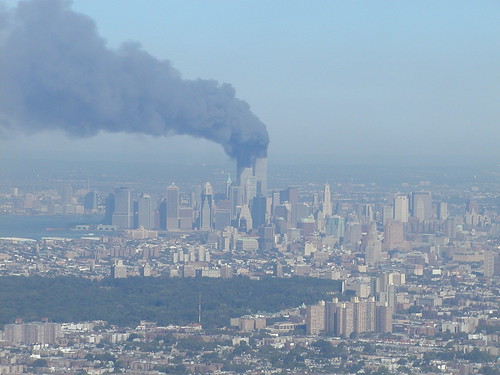 students about one of the worst days in America's, and the world's, history. YouTube makes watching the entire 1 hour and 40 minutes possible for free, so teachers, parents, and students can play it as many times as necessary.
use in front of classes. It is a mixture of many videos taken while the Twin Towers were being burned down, edited in such a great way that every minute of the event is covered with news broadcasts, police radio recordings, etc. This video explains not what talk show hosts think the reason was behind the attack, but what common people were thinking while many of their loved ones were being murdered. This is also a great documentary to show due to the fact that many of us kids were too young to remember, and learning about this calamity answers many questions that linger on the back of our minds. It is completely appropriate, and is a wonderful way to teach students about one of the worst days in America's, and the world's, history. YouTube makes watching the entire 1 hour and 40 minutes possible for free, so teachers, parents, and students can play it as many times as necessary.
My 8th grade History teacher showed this to my class yesterday, the 11th anniversary of the tragedy of 9/11. This is the reason I decided to write about how great of a video this is.
Wednesday, August 22, 2012
The Death of a World Famous Director
 |
| Courtesy of ABC News.com |
Wednesday, August 1, 2012
Summer Olympics 2012
London 2012
The Olympics have begun! On July 27th the Opening Ceremony was held at the Olympic Stadium. Danny Boyle had $42.1 million (£27 million) spent on this, yet I found it pretty disappointing. I admit that it contained many outstanding performances and seems to have taken a lot of effort to plan. Also, it showed the whole history of London, and how it became what it is today. Even so, it wasn't relevant to the Olympics, and it wasn't as entertaining as an Opening Ceremony should be.
The Olympics have begun! On July 27th the Opening Ceremony was held at the Olympic Stadium. Danny Boyle had $42.1 million (£27 million) spent on this, yet I found it pretty disappointing. I admit that it contained many outstanding performances and seems to have taken a lot of effort to plan. Also, it showed the whole history of London, and how it became what it is today. Even so, it wasn't relevant to the Olympics, and it wasn't as entertaining as an Opening Ceremony should be.
 |
| Courtesy of JLO8 |
Now, 5 days in, the Olympics are going great. The top countries in terms of medals so far are China with 30 total medals, the US with 29 total, and Japan with 17 medals. Out of the 32 sports played, I am watching swimming the most. The two best American swimmers in Beijing were world famous Michael Phelps and Ryan Lochte. Michael Phelps was born in Baltimore, MD in 1985. He has won 8 gold medals in Beijing and now has a total of 15 gold medals, 2 silver, and 2 bronze, making him the most decorated Olympian in history. Ryan Lochte was born in Rochester, NY in 1984. He is Phelps' top rival, with 5 gold, 2 silver, and 2 bronze.
Click here to view a news clip for the Opening Ceremony.
Subscribe to:
Posts (Atom)